Transaction monitoring is the practice of analyzing payment data typically in real time, at the ISO 8583 message or API payload level to detect fraud, scheme violations, and laundering as they happen, rather than after the chargeback or audit catches up. For acquirers, PSPs, and payment facilitators, it is the operational core of payment fraud prevention: the system that sits between the authorization flow and the rest of the risk stack.
The business case for transaction monitoring acquirers can articulate has gotten sharper over the last several years, but the underlying technology in many programs has not moved. A meaningful share of acquiring portfolios still run on static, rules-based engines whose logic has not materially changed since they were originally configured. Those engines were built for a fraud landscape that no longer exists.
This guide walks through what transaction monitoring actually has to do today, why static rules structurally fail, and what to look for in a system built for real-time, adaptive fraud and laundering detection across a modern merchant portfolio.
Why static rule engines no longer work
Legacy transaction monitoring systems treat fraud as a fixed-pattern problem. Configure a velocity threshold; flag transactions over a value limit; reject any volume from a list of known bad BINs. That logic is straightforward, transparent, and — for the fraud patterns it was designed against — broadly effective.
The problem is that fraud is not a fixed-pattern problem. Sophisticated transaction laundering operations adapt their behavior continuously to stay under the thresholds the rules engine was configured to catch. A laundering operation that breaks transactions across multiple lower-value attempts, distributes them across several merchant identifiers, and times them against the velocity windows the engine measures will produce no individual flag — and the aggregate pattern that would expose it never gets evaluated, because the engine was not built to look at the aggregate.
Multi-vector fraud compounds the problem. A single laundering scheme can touch a merchant's checkout flow, payment routing, MCC declaration, and beneficial ownership simultaneously. Each vector in isolation looks within tolerance. Looked at together, the picture is unambiguous. A static rules engine that scores each vector independently has no mechanism to combine them, which is why so much modern laundering activity gets flagged retroactively rather than caught in real time.
The shift in what acquirers need from a transaction monitoring system has been from "match the known patterns" to "detect the patterns we haven't seen before." That is a different problem with different tooling.
What Transaction Monitoring actually covers
A modern transaction monitoring system operates on multiple inputs at once and applies layered logic to each.
Real-time ISO 8583 analysis
The foundation is the ability to capture and process live transaction data — ISO 8583 messages, API payloads from gateways and acquirers, settlement data from the processor — at the rate they actually arrive. Real time matters because the window between an unauthorized routing attempt and downstream chargebacks or scheme penalties is short. Processing the data hours later is a different product than processing it as it happens.
The integration also has to happen without slowing down core authorization. A monitoring system that adds latency to the auth flow will be turned off the first time it costs the acquirer a meaningful share of their authorization rate. The system has to scale dynamically against transaction spikes without affecting throughput.
Adaptive Rule Engines
Static rules are a starting point, not an endpoint. An adaptive rule engine continuously learns from historical transaction data, generating and updating detection logic based on patterns that emerge in the actual portfolio rather than patterns the team configured manually months ago. New laundering schemes get caught by the same mechanism that caught the previous generation, without requiring a manual reconfiguration after every fraud cycle.
This is what makes adaptive monitoring different from generic machine learning bolted on top of an old engine. The detection logic is the model, not a layer beside it.
Velocity and Pattern Detection
Rapid-fire fraud — multiple attempts compressed into a short window, distributed across BINs, geographies, or merchant identifiers — is one of the most common attack patterns in modern payment fraud prevention. Velocity rules at the merchant, card, IP, and device level catch this in real time, but only if they operate together. Cross-rule intelligence is what closes the gap between "high velocity from one card" and "coordinated velocity from a BIN range across five merchants."
Cross-signal Verification with Merchant Behavior
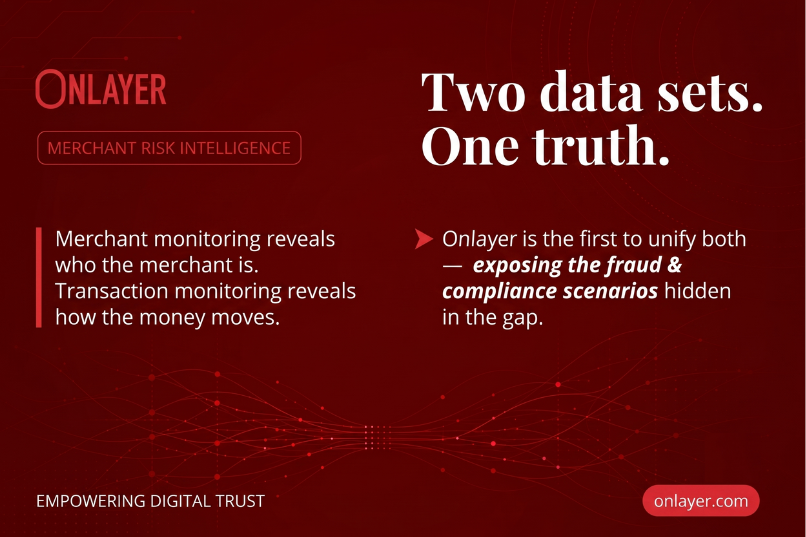
This is the layer that separates transaction monitoring built for acquirers from generic fraud tooling. A transaction stream evaluated in isolation can look fine while the merchant behind it is running a scheme that would be obvious from the website. A merchant declared as a kitchenware retailer, processing volume that aligns with a gambling operation, is a transaction monitoring signal — but only if the system has access to the website-level data to compare against.
Connecting the live transaction stream to the merchant's web presence, advertised pricing, traffic profile, and MCC declaration is what makes cross-signal verification possible. It is also what catches MCC misclassification that pure transaction rules cannot.
White, Black, and Watch List Integration
Real-time decisioning needs to consume both internal and external lists — known good BINs, known bad cards, watchlisted merchants, sanctioned counterparties — without batch latency. Lists need to be maintained dynamically and reflected in decisioning within seconds, not hours. This is also where AML and sanctions screening integrates with transaction monitoring rather than running as a separate process.
Transaction Monitoring vs. Issuer-side Fraud Monitoring
A common source of confusion is treating issuer-side and acquirer-side transaction monitoring as the same problem. They are not.
Issuer-side fraud monitoring is fundamentally about cardholder behavior. The signals are about the card, the cardholder, and the transaction context — was this card stolen, is the spending pattern unusual for this cardholder, does the geography match. The decisions are made at the BIN-issuer relationship, and the cost of a false positive is a declined transaction.
Acquirer-side transaction monitoring is about merchant behavior. The signals are about the merchant — is the volume consistent with the declared business, is there evidence of laundering, are transactions being routed through unauthorized URLs. The decisions are made at the acquirer-merchant relationship, and the cost of missing a signal is a scheme fine, a chargeback liability, or a damaged acquiring license.
Both functions matter, but tooling built for one rarely fits the other. Acquirers using consumer-side fraud platforms for merchant transaction monitoring routinely find themselves missing the signals their actual risk profile depends on.
How Transaction Monitoring Works in Practice
A working transaction monitoring program runs across three connected layers.
The capture layer integrates directly into the acquirer's payment infrastructure — ISO 8583 streams, gateway APIs, processor feeds — and ingests transaction data as it occurs without affecting authorization throughput. The integration is designed to be additive, not in-line, so it can be deployed without changing the core auth path.
The decisioning layer applies the rule set: adaptive engine output, configured velocity thresholds, watchlist matches, and cross-signal correlations against merchant data. Each transaction generates a structured score and, where the rule set requires, an action — flag for review, route to investigation, or block. The decisioning needs to operate at sub-second latency for it to function as a real-time control.
The investigation layer routes alerts into the workflow risk teams actually use. That usually means a case management system or a risk dashboard, with the underlying transaction record, merchant context, and prior alert history attached. Generating raw alerts without context creates work; generating prioritized, context-attached cases gets remediation done.
A serious transaction monitoring program also produces a clean audit trail: every decision, every rule trigger, every analyst action, captured automatically. When the scheme or the regulator asks how a decision was made, the answer has to be a defensible record produced on demand.
Transaction Signals: What the data Is telling you
The most useful signals in transaction monitoring acquirers tend to look at fall into three categories.
Volume-versus-declared-model mismatches are the highest-conviction laundering indicators. A merchant whose monthly processing volume is materially out of step with the volume the website's traffic and product range can plausibly explain is a flag worth investigating immediately, regardless of whether the transactions individually pass velocity rules.
Routing anomalies are the next layer. Transactions that route through unexpected gateway endpoints, that touch unregistered domains, or that produce different processor URLs at the test transaction layer than the merchant has declared are strong indicators of unauthorized aggregation or hidden routing. These signals only surface if the monitoring system has visibility into the actual checkout flow, not just the cleared transaction record.
Pattern combinations against external context are the third layer. A merchant showing a sudden velocity spike at the same time their website category has changed and their reputation profile has deteriorated is producing a pattern that no single transaction rule will catch. Cross-signal verification against merchant monitoring data is what makes the combination visible.
What to look for in a Transaction Monitoring System
When evaluating transaction monitoring systems for acquirers, the questions that matter are about depth and adaptability rather than feature lists. Does the engine adapt continuously based on portfolio behavior, or does it rely on rules that have to be reconfigured manually? Does it integrate live ISO 8583 streams without adding authorization latency, and can it scale against transaction spikes without affecting throughput? Does it cross-verify transactions against merchant-level data — website, MCC, traffic, pricing — or does it operate only on payment data in isolation?
Watchlist handling matters too. Real-time integration of internal and external lists is table stakes; what differentiates strong systems from weak ones is the ability to update lists dynamically, with decisioning reflecting the change in seconds rather than hours.
Operational integration is the third filter. A transaction monitoring system that produces alerts in its own UI but does not flow into the case management, CRM, or audit system the team already uses creates duplicate work. RESTful APIs and hook-driven case creation are not optional.
For acquirers operating across regions, look explicitly for support for jurisdiction-specific rule variation — local MCC interpretations, regional AML expectations, and central bank merchant oversight requirements often differ enough to need configuration rather than a single global ruleset.
How Onlayer Automates Transaction Monitoring
Onlayer's Transaction Monitoring Service is built specifically for the realities of acquirer-side fraud and laundering detection. The adaptive rule engine continuously learns from historical transaction data to detect complex laundering schemes, with cross-rule velocity intelligence catching multi-vector fraud patterns in real time. White, black, and watch lists integrate seamlessly into live decisioning, with updates reflected in milliseconds rather than batches.
The system captures live ISO 8583 messages and API payloads as they occur, scales dynamically against transaction spikes, and integrates without disrupting the core authorization flow. Cross-signal verification correlates live transaction behavior directly against real-world website activity, advertised pricing, traffic patterns, and MCC validation — exposing discrepancies between declared business models and actual processing volume that pure transaction rules consistently miss.
The service is built to operate alongside Onlayer's Merchant Monitoring Service and Merchant Onboarding Service, so risk teams see transactional and external signals in a single connected view. For laundering specifically, Transaction Laundering Detection — powered by Onlayer's proprietary C.A.R.V.E.™ AI — sits on top of transaction data to map shadow networks and proxy setups before they hit the ledger. BRAM and VIRP and AML and Sanctions Checks round out the compliance stack, with every decision captured automatically into an audit-ready record.