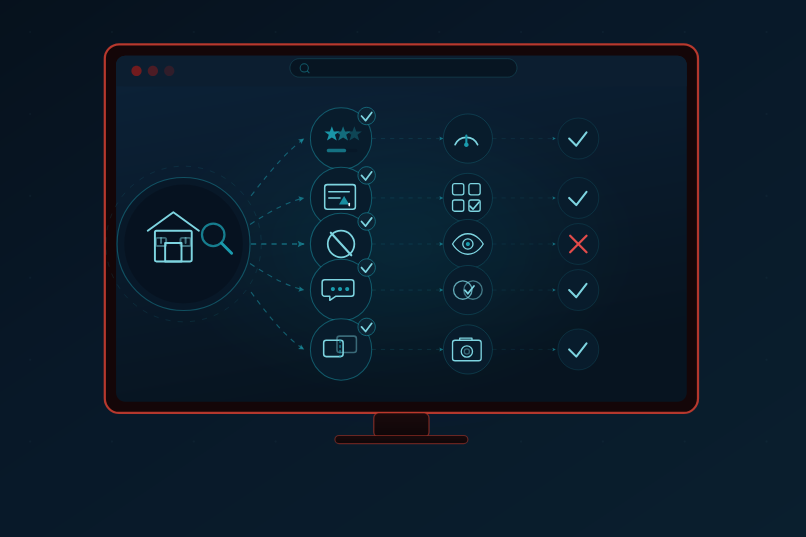
Merchant reputation checks are the structured evaluation of public signals about a merchant across review platforms, forums, marketplaces, app stores, and external complaint and blacklist databases to surface reputational, fraud, and chargeback risks that internal KYM processes do not see. For acquirers, PSPs, and payment facilitators, it is the layer that adds external public sentiment and trust intelligence to the merchant compliance program, catching the merchants whose internal records look clean but whose public footprint tells a different story.
The case for reputation screening has moved over the last several years from "nice supplementary signal" to "expected component of digital due diligence." Card schemes, regulators, and central banks increasingly assume that acquirers monitor public sentiment and external risk signals as part of demonstrating active oversight. Merchants generate reputation footprints whether they intend to or not, and the merchants whose footprints are problematic are systematically the merchants the acquirer would most want to know about before approving or continuing to process for them.
This guide explains what merchant reputation checks actually cover, how the screening operates in practice, and what to look for in a reputation checks provider built for the realities of acquiring portfolio risk.
Why public reputation is now a risk signal
Reputational risk used to be a marketing concern. The merchant cared about it; the acquirer did not, beyond the chargeback profile that reputation eventually produced. That separation no longer holds.
The first reason is that reputation is a leading indicator of chargeback waves. Customer complaint volume on review platforms typically rises weeks before chargebacks land in the issuer queue. Acquirers that monitor reputation signals see the developing problem early and can engage with the merchant before the financial exposure materializes. Acquirers that do not monitor reputation signals get blindsided by the chargeback wave and the BRAM/VIRP exposure that often accompanies it.
The second reason is that public reputation is the surface where merchant evasion frequently shows up. Merchants who have been blacklisted by previous acquirers, banned from marketplaces, or named in fraud investigations carry that history in their public footprint. Internal KYM that looks only at the merchant's declared identity will not see the prior bans; reputation checks scanning external forums, blacklists, and adverse media will.
The third reason is that brand impersonation and cloned listings affect both legitimate merchants and the acquirers processing for the impersonators. The legitimate merchant whose brand is being impersonated has limited ability to detect this; the acquirer who is processing for the impersonator has limited ability to know without scanning external listings. Reputation checks are the layer that catches the pattern.
The fourth reason is regulatory. The expectation that acquirers conduct continuous, complete digital due diligence including external sentiment and trust signals, is now embedded in scheme guidance and regional regulator expectations. Programs that skip this layer leave their compliance posture demonstrably incomplete.
What merchant reputation checks actually cover
Effective reputation checks are a layered scanning discipline. Each layer addresses a different category of public signal.
Review platforms (Trustpilot, Yelp, Google, App Stores)
The foundation is automated scanning of major review platforms — Trustpilot, Yelp, Google Reviews, app store listings, and the broader long tail of platform-specific review sources. The scanning collects review volume, rating distribution, sentiment trend, and topic concentration, normalizing across platforms so the per-merchant view is consistent regardless of where the reviews live.
Working programs scan 50+ external platforms and produce risk-adjusted portfolio scoring based on real-time public sentiment. The scoring matters because review volume alone is not the signal — a merchant with 500 reviews and a stable 4.0 rating is materially different from a merchant with 50 reviews and a sharp negative trend, and the scoring has to capture the difference.
Forum and marketplace scanning
The second layer extends beyond formal review platforms into the long tail of consumer-complaint forums, scam-tracker communities, marketplace seller threads, and category-specific platforms where merchants get discussed by customers. Reddit, BBB-style forums, regional consumer forums, and category-specific watchdog sites all carry signals that mainstream review platforms do not.
Forum scanning is operationally harder than review platform scanning — the volume of noise is higher, the post structure varies, and the signals require contextual analysis to extract. But the yield is meaningful, particularly for catching merchants whose public reputation has surfaced in non-mainstream channels before it reaches the mainstream platforms.
Adverse media and external blacklists
The third layer is direct adverse media screening — news coverage, regulatory action announcements, fraud investigation reports — tied to the merchant entity, beneficial owners, or controlling parties. Adverse media overlaps with AML signal sets, but reputation checks typically extend the screening to a broader source set focused on consumer harm and operational misconduct rather than narrowly on financial crime.
External blacklists are the parallel signal. Independent scam-tracking databases, consumer protection blacklists, and category-specific banned-seller lists carry merchant identifiers (URLs, business names, beneficial owner names) that surface previously banned operators attempting to re-enter the ecosystem under new acquirers. Catching these at onboarding is a high-value detection.
Impersonation and cloned listing detection
The fourth layer maps merchants across e-commerce marketplaces and app stores to flag impersonation risks, cloned listings, and unauthorized brand usage. This layer extends merchant due diligence into the surfaces where bad actors most actively impersonate legitimate businesses, and it produces signals that protect both the legitimate brand and the acquiring portfolio from processing impersonator volume.
Detection here requires entity-level matching rather than pure name matching — orthographic variants, language localization, and visually similar handles all need to surface as potential impersonation signals warranting review.
Reputation checks vs. social media screening
A common conflation: that reputation checks and social media screening are the same function with different names. They overlap, but they cover different surfaces.
Social media screening operates on the social platforms; Instagram, TikTok, Telegram, LinkedIn, Facebook, Twitter/X. The signals are off-domain commerce, brand impersonation on social channels, customer complaint trend on social posts, and behavioral patterns within the social platform itself.
Reputation checks operate on the broader public surface review platforms, marketplaces, forums, app stores, news media, external blacklists. The signals are public sentiment scoring, formal review trends, marketplace listing patterns, and categorical adverse media.
The two functions are complementary. A merchant generating customer complaints on social will often also generate them on Trustpilot and Google Reviews; the cross-platform consistency is itself a stronger signal than either platform individually. A working compliance program runs both, with the outputs surfacing in a unified case view rather than across parallel dashboards.
How reputation checks work in practice
A working merchant reputation checks program runs continuously and integrates with the rest of the compliance stack.
At onboarding, the merchant entity is scanned against the configured platform set review; platforms, forums, marketplaces, adverse media, blacklists and the public reputation profile flows into the decisioning workflow alongside the KYM and AML outputs. Clean profiles approve through; problematic profiles route to enhanced due diligence with the underlying evidence attached.
Continuous monitoring runs on a configured cadence across the active portfolio. Review trends, sentiment shifts, complaint volume changes, and new adverse media appearances all generate alerts in the case management workflow. Trend reporting at portfolio level surfaces the directional signals — merchants whose reputation profile is degrading, categories whose collective sentiment is shifting — that individual case alerts would not.
Investigation is supported by the captured evidence. Compliance team members reviewing alerts see review excerpts, sentiment scoring, complaint topic analysis, and the timeline of changes in the merchant's public profile. Decisions are captured automatically into the audit record.
Reporting and audit support cover both case-level outputs and portfolio-level trend metrics. Exportable timestamped screenshots, sentiment scores, and risk tags strengthen audit-ready due diligence and support immediate operational decisions when remediation is required.
Reputation signals: what the data is telling you
The most useful reputation signals tend to fall into three categories.
Trend changes are the highest-value category. A merchant whose review profile has been stable and is now degrading sharply — falling rating, rising complaint volume, shifting sentiment around delivery or refund topics — is producing a leading indicator of operational change that frequently precedes chargeback waves. The trend is the signal; the absolute current rating is secondary.
Topic concentration is the second category. A merchant with high complaint volume concentrated on specific operational issues — non-delivery, defective goods, aggressive billing, refund refusal — is producing a different risk profile than a merchant with the same volume distributed across diverse topics. Concentrated complaints tend to indicate systemic issues that compound, rather than ordinary noise.
Cross-source consistency is the third category. A merchant whose negative signals appear consistently across review platforms, forums, and adverse media is producing a higher-conviction signal than a merchant with isolated negative signal on a single source. Cross-source aggregation is what converts individual reviews into structured intelligence.
The combinations matter. A merchant with a deteriorating trend, complaint concentration on operational issues, and consistent cross-source negative signal is producing a high-conviction risk profile that warrants action. A merchant with any one of those signals in isolation typically does not.
What to look for in a reputation checks provider
When evaluating reputation checks providers, the questions that matter are about source breadth, signal quality, and operational integration. Does the provider scan the major review platforms — Trustpilot, Yelp, Google, app stores — and the long tail of forums and marketplaces relevant to the operating geographies? Does it cover adverse media and external blacklists, or only review platforms?
Signal processing is the second filter. The provider should produce risk-adjusted sentiment scoring, topic analysis, trend tracking, and cross-source consistency scoring — not just raw review feeds. A provider that delivers feeds without scoring pushes the analytical work back onto the compliance team.
Evidence handling is the third. Timestamped screenshots, captured review excerpts, sentiment scores, and risk tags should be exportable as standard outputs supporting both case management and audit response. Without evidence handling, the screening produces operational signals but not defensible records.
Integration is the fourth. Reputation checks that operate as a separate dashboard create parallel infrastructure and inconsistent records. Integration into the merchant onboarding, monitoring, and case management systems the team already uses is what makes the screening operational rather than supplementary.
For acquirers operating across geographies, regional source coverage is the fifth filter. Review platforms, forums, and consumer-protection databases vary by region, and a provider whose source set is concentrated in one geography will produce inconsistent coverage elsewhere.
How Onlayer automates merchant reputation checks
Onlayer's Reputation Checks extend merchant compliance into the external public sentiment layer. The service analyzes public reviews across 50+ external platforms — including Trustpilot, Yelp, Google Reviews, and app stores — enabling risk-adjusted portfolio scoring and remediation tracking based on real-time public sentiment, with sentiment-based alerts and summary reports delivered directly to risk and sales teams.
For fraud and scam signals specifically, the service identifies up to 3x more fraud risk indicators than internal KYM sources alone, detecting external blacklists, scam tags, unresolved complaints, and poor public ratings automatically. Merchants with prior bans or scam reports get caught definitively before the approval process completes the kind of signal that internal data simply does not have access to.
For impersonation and cloned listings, the service maps merchant presence and operational behavior across major e-commerce marketplaces and global app stores, flagging severe impersonation risks, cloned listings, and unauthorized brand usage instantly. Audit-ready outputs; timestamped screenshots, sentiment scores, and risk tags export directly into case management systems supporting both immediate remediation and downstream compliance review.
The service integrates seamlessly with Merchant Onboarding Service and Merchant Monitoring Service, so external reputation signals appear alongside KYM, AML, and behavioral data in a unified compliance view. Social Media Screening extends the same external-signal logic into the social platforms; AML and Sanctions Checks handle the formal regulatory screening alongside the broader reputational coverage. The combined stack is what closes the gap between internal merchant records and external public reality and gives risk teams the digital due diligence depth that modern oversight standards now expect.