Two Halves of One Truth
Why merchant monitoring and transaction monitoring belong together and why reading them apart leaves fraud and compliance risk hidden in plain sight.
For most acquirers, PSPs, and platforms, merchant risk is managed in two separate rooms. In one room sits merchant monitoring the discipline of understanding who a merchant really is: what they sell, what their website and social channels say, whether their content breaches scheme rules, and what their reputation looks like across the open and dark web. In the other room sits transaction monitoring — the discipline of understanding how money actually moves: payment velocity, value patterns, processing volumes, and the tell-tale signatures of laundering hidden inside the authorization stream.
Both disciplines are mature. Both are necessary. And both, on their own, are half-blind. The fraud and compliance failures that cost institutions the most — transaction laundering, post-approval merchant drift, scheme violations, coordinated shell networks — live precisely in the space between the two. They are invisible to either discipline alone and obvious only when the two are read as a single signal.
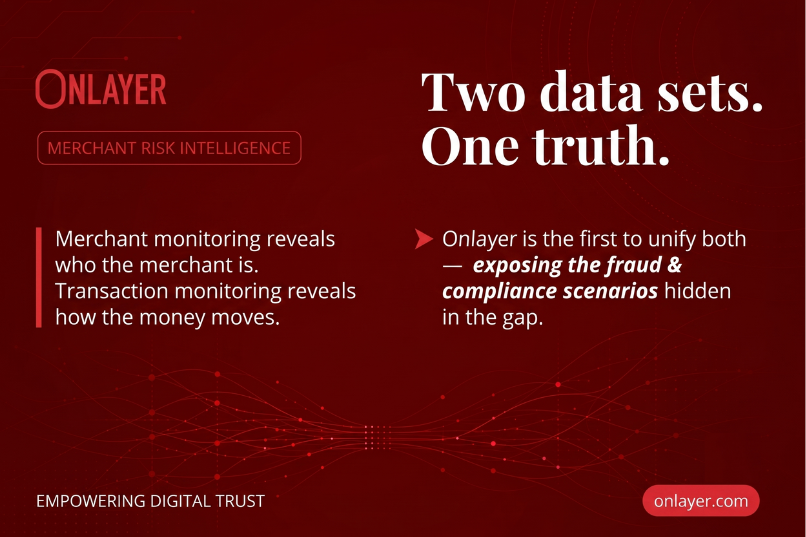
Merchant monitoring tells you who the merchant is. Transaction monitoring tells you how the money moves. Neither, on its own, tells you the truth.
THE TWO DISCIPLINES
Two views of the same merchant
Merchant monitoring intelligence answers the question of identity and intent. Onlayer's Merchant Monitoring Service crawls more than 250 data points per merchant, continuously scanning websites and redirect URLs for BRAM and VIRP exposure, screening social and review channels for brand abuse and complaint spikes, and watching the dark web for leaked credentials and cloned storefronts. It is the discipline of context: it knows whether a merchant is selling what it claims to sell, and whether the world considers it trustworthy.
Transaction monitoring data answers the question of behavior. Onlayer's Transaction Monitoring Service captures real-time ISO 8583 and API payloads, applies an adaptive rule engine that learns from historical patterns, runs velocity and cross-rule checks for multi-vector fraud, and flags discrepancies between a merchant's declared MCC and its actual processing volume. It is the discipline of evidence: it knows what the money is doing, in the moment, at scale.
Each view is internally complete and externally partial. Merchant monitoring sees the storefront but not the money. Transaction monitoring sees the money but not the merchant. The institutions that run them separately are, in effect, asking two expert witnesses to testify in two different courtrooms — and never letting them compare notes.
THE BLIND SPOT
Where the ecosystem leaves a gap
When merchant intelligence and transaction data are siloed, the risk does not disappear — it simply falls between them. A merchant can present a flawless, compliant website while its processing volume tells a completely different story. A transaction stream can look statistically ordinary while the merchant behind it has quietly swapped its catalogue for prohibited goods. Each system reports green. The institution carries a risk it cannot see.

Each discipline has a blind spot; Onlayer joins both into a single signal that closes the gap.
This is the structural gap in the merchant-risk ecosystem. Tooling has historically been built around one discipline or the other — content scanners on one side, transaction rule engines on the other — with integration left as an exercise for the customer. The result is that the highest-value detections, which by definition require both data sets, are the hardest ones to make.
WHAT ONLY EMERGES TOGETHER
The scenarios that stay hidden until you connect both
The clearest argument for unifying the two disciplines is the set of threats that are undetectable in isolation. Each of the following becomes visible only when a merchant signal and a transaction signal are correlated against one another.
Four high-cost threats that surface only when merchant intelligence and transaction data are read together.
Transaction laundering. A storefront that looks clean, compliant, and unremarkable processes volumes that do not match its declared business. The website passes every content check; the MCC-to-volume mismatch is the only tell. Onlayer's transaction laundering detection, powered by the proprietary C.A.R.V.E. AI engine, correlates IPs, DNS records, and online-presence traces against live transaction behavior to expose illicit factoring with up to four times the accuracy of manual review.
Post-approval merchant drift. A merchant approved against a legitimate catalogue later swaps in prohibited content. Static onboarding checks never see it. But the content change registers in merchant monitoring at the same moment a processing-volume spike registers in transaction monitoring — and together they surface a live BRAM/VIRP violation before the scheme does.
Incoming chargeback waves. A surge of complaints on external review platforms is a reputational signal; a surge in chargeback velocity is a transactional one. Apart, each is noise. Together, they are an early-warning system for a chargeback wave that lets risk teams intervene while there is still time to act.
Hidden shell-merchant networks. Multiple merchants sharing an IP or DNS footprint is a merchant-intelligence pattern; coordinated payment routing across those same accounts is a transaction pattern. Mapped together, they reveal a single bad actor operating behind a network of fronts — the kind of structure that drains an acquiring portfolio and triggers scheme penalties when it is finally discovered downstream.
ONE LIFECYCLE, ONE SIGNAL
How Onlayer connects the ecosystem
Onlayer was built to manage the entire merchant lifecycle in one place — from discovery and onboarding through continuous monitoring — rather than as a point tool bolted onto someone else's stack. That architecture is what makes unification possible. Lead generation, automated onboarding, and live monitoring run on the same platform, and the monitoring stage is fed simultaneously by merchant intelligence and transaction data.
Because the two streams share a platform, the Transaction Monitoring Service can cross-verify live transaction behavior against website activity, pricing, and traffic captured by merchant monitoring — and the Merchant Monitoring Service can prioritize its scans based on the anomalies transaction data surfaces. The integration is not a nightly batch reconciliation between two vendors; it is a single, continuously updated view of each merchant in the portfolio.
WHY THIS MATTERS NOW
The pioneer of unified merchant-risk intelligence
Onlayer is the first to deliver merchant monitoring intelligence and transaction monitoring data together as one signal — and that combination is precisely what exposes the hidden scenarios above. The market has long offered content scanning and transaction rule engines as separate products. Onlayer's position as a Mastercard Technology Provider and certified Merchant Monitoring Service Provider (MMSP), combined with a platform spanning 150+ country-specific compliance frameworks and more than 20 million merchants scanned, lets it do what fragmented tooling cannot: turn two partial views into one complete picture.
For compliance teams, that means catching BRAM and VIRP violations as they happen rather than when a scheme fine arrives. For fraud and risk teams, it means seeing laundering and shell networks that no single data set would reveal. For the broader payments ecosystem, it means closing the structural gap that bad actors have relied on for years. The cost of leaving the two disciplines apart is measured in penalties, chargebacks, and lost trust. The value of joining them is measured in the threats you can finally see.
The most dangerous merchant risks do not hide inside merchant data or inside transaction data. They hide in the space between; which is exactly the space Onlayer was built to close.